Abstract:
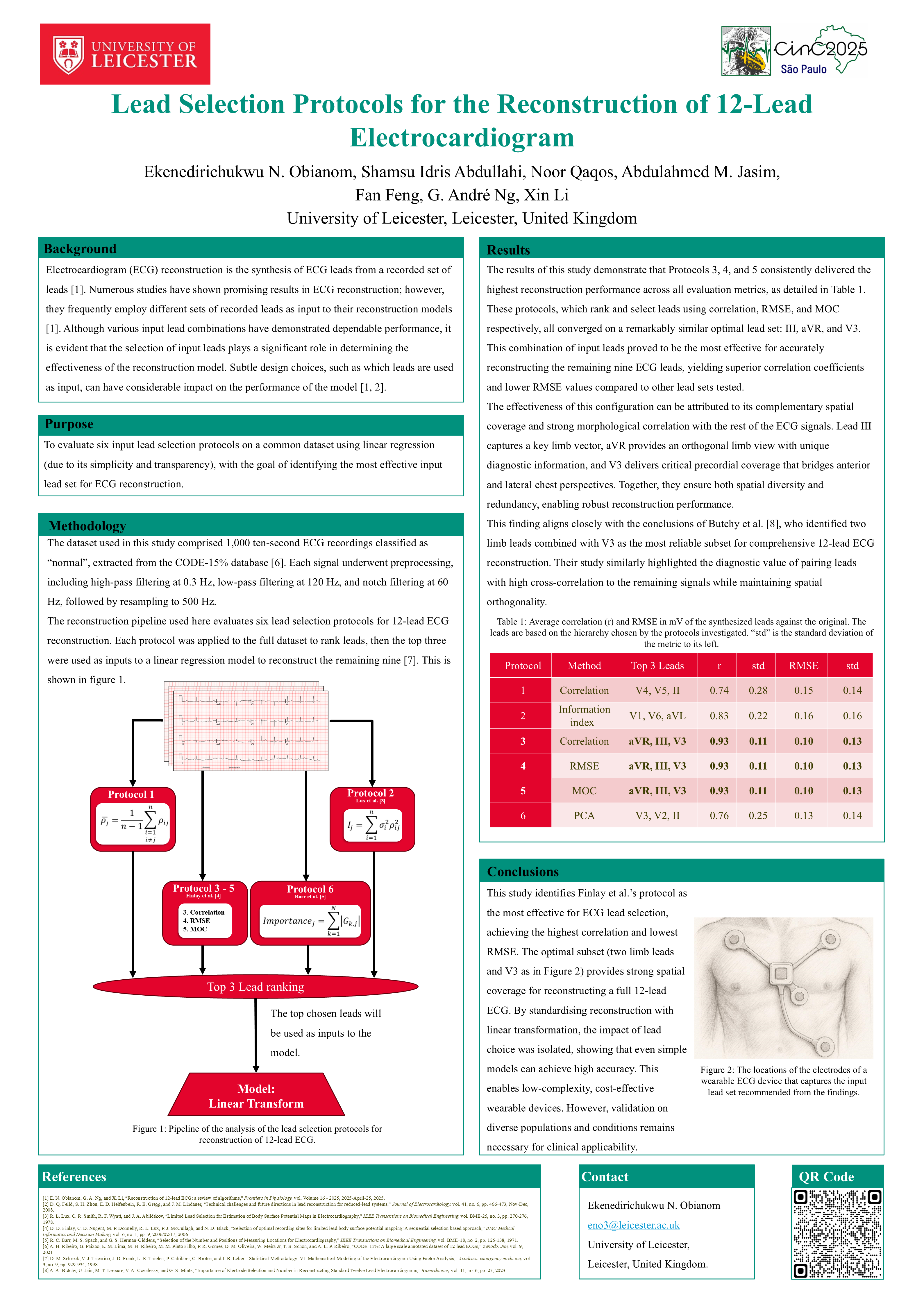
Electrocardiogram (ECG) lead reduction and signal reconstruction are critical for enabling compact, wearable cardiac monitoring systems. This study builds on years of foundational research by systematically evaluating various lead selection protocols to determine the most effective subset of leads for reconstructing a full 12-lead ECG.
Unlike previous studies that often conflate lead selection with reconstruction techniques, this work decouples the two by applying a standardized linear transformation method across all protocols. Among the evaluated approaches, the protocol proposed by Finlay et al. demonstrated the highest performance, achieving a correlation coefficient of 0.93 and the lowest RMSE of 0.10mV. Three protocols consistently identified the same optimal lead set (III, aVR, and V3) highlighting its reliability. These three leads offer strong spatial diversity and high correlation with the remaining ECG signals, making them highly effective for signal reconstruction.
The findings have practical implications for the development of efficient and cost-effective wearable ECG devices. By using a standardized, evidence-based lead subset, even simple reconstruction models can achieve high performance, reducing the need for complex algorithms and enabling scalable health technology solutions.
This was presented as a poster in CinC 2025, Sao Paulo, Brazil.
The link to the full paper is:
Leave a Reply