(Preliminary Study)
Part 1: Reconstruction without Denoising
Abstract:
Promising results have been shown in previous studies for the reconstruction of 12-lead electrocardiogram (ECG) using machine learning techniques. Reliable results have also been shown for denoising ECG with machine learning tools. These two tasks (denoising and reconstruction) are typically handled separately, but this does not have to be. This paper aims to construct 5 denoised ECG leads from a subset of 3 noisy ECG leads. It also aims to analyse the performance of the models over 5 different noise levels. 30s ECG signals were acquired from 80 patients in PTB database. They were denoised and resampled to 500Hz. Different levels of gaussian noise (0dB, 5dB, 10dB, 15dB, 20dB) were added to lead I, II and V3. Linear regression (LR) and long short-term memory (LSTM) models were trained at the different noise levels to predict denoised leads V1, V2, V4, V5, and V6. 80% of the data was used to train the model and 20% was used to test. The average values of Pearson correlation (r), root-mean-square error (RMSE) and signal-to-noise ratio (SNR) against the baseline at 0db were 0.79±0.12, 0.12±0.05mV, and 4.26±2.41dB for LR and 0.87±0.15, 0.10±0.05mV, and 6.42±3.34dB for LSTM respectively. At 20dB they were 0.91±0.10, 0.08±0.05mV, and 7.73±3.99dB respectively for both models. Both models showed similar performance in higher input SNR. As the input SNR reduced, LSTM model showed a more stable performance. At higher input SNR, LR is recommended, whereas at lower input SNR, LSTM is the better option.
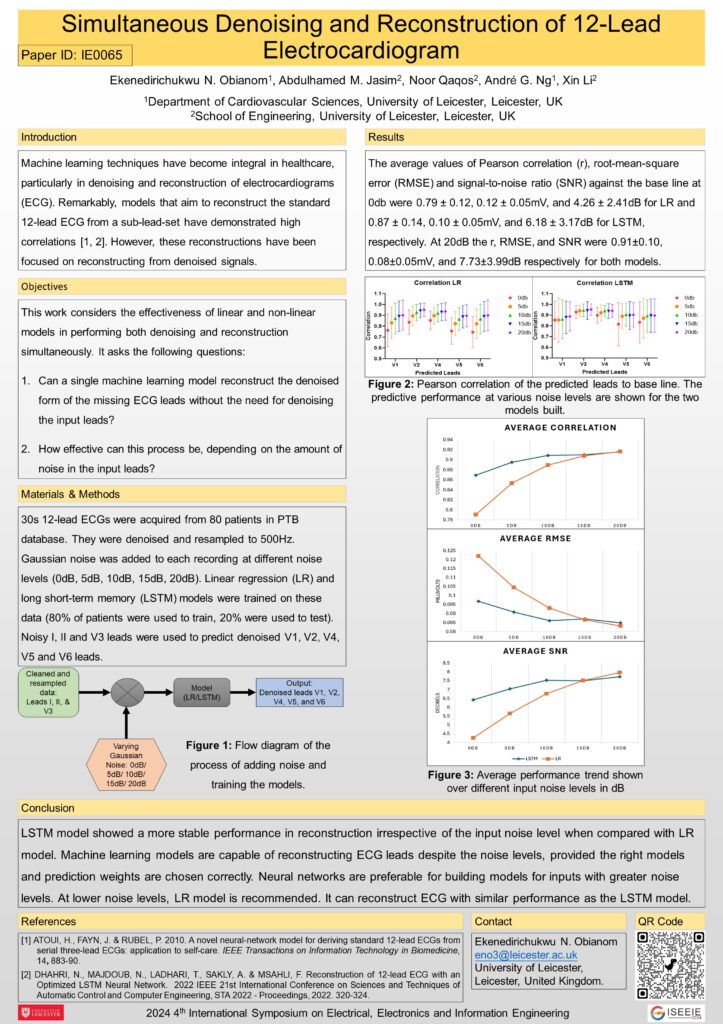
This was presented at the ISEEIE, Leicester, UK. The link to the full paper is:
Part 2: Classification of Noise
Abstract:
Electrocardiogram (ECG) signals, like many biological and electronic signals, are vulnerable to external noise. These distortions can impair signal interpretation, especially by medical practitioners and automated or remote systems. Accurate signal-to-noise ratio (SNR) estimation is crucial for adaptive filtering and noise-aware processing. This paper presents a lightweight classification model to estimate SNR levels in noisy ECG signals, serving as a preprocessing step for the SNR-based ECG reconstruction framework by Obianom, Jasim, Qaqos, Ng, and Li. The approach is also applicable to other noisy time-series data.
Ten-second ECG lead I recordings from 4,250 patients in the CODE-15% database was used in this study. Each signal was denoised, resampled to 500 Hz, and augmented with 21 levels of gaussian noise (0–20 dB in 1 dB increments). A decision tree model was trained on 3,500 samples to classify SNR into five categories: A (0–4 dB), B (5–9 dB), C (10–14 dB), D (15–19 dB), and E (20 dB). The model achieved 98% accuracy, mean F1 score, precision and recall of 0.973, 0.979, and 0.969 respectively using only four features: spectral centroid, spectral entropy, power bandwidth, and spectral skewness. Due to its low computational demand and high accuracy, this method is highly suitable for integration into real-time, low-resource systems such as wearable ECG monitors. Furthermore, the approach may be adapted for broader applications in electronic signal processing, where adaptive noise estimation can significantly improve performance and efficiency in embedded devices.
This was presented at the ISEEIE, Taizhou, China. The link to the full paper is:
Leave a Reply