(Preliminary Study)
Part 1
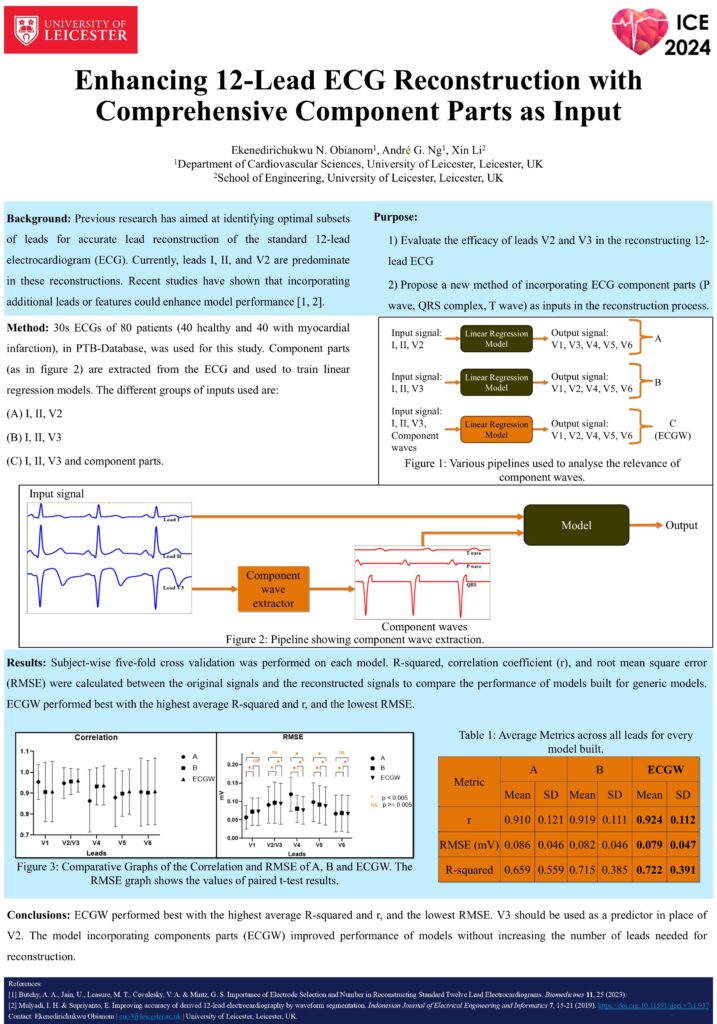
Background: Previous research has aimed at identifying optimal subsets of leads for accurate lead reconstruction for full standard 12-lead electrocardiogram (ECG). Currently, I, II, and V2 are predominate in these reconstructions. Recent studies have shown that incorporating additional leads or features could enhance model performance.
Purpose: The primary aim of this work is to enhance ECG reconstruction performance by 1)evaluating the efficacy of leads V2 and V3 in the reconstructing 12-lead ECG, while also 2)proposing a new method incorporating ECG component parts (P wave, QRS complex, T wave) as inputs in the reconstruction process.
Method: 30s ECGs of a group of 80 patients (40 healthy and 40 with myocardial infarction), in PTB-Database, was used for this study. Component parts (as in figure 1b) are extracted from the ECG. Various linear regression models were built using the least square method. The different groups of inputs used are (A) I, II, V2 (B) I, II, V3 (C) I, II, V3 and component parts. The R-squared, correlation coefficient (r), and root mean square error (RMSE) are calculated between the original recorded signals and the model-reconstructed signals to compare the performance of models built for both generic models and patient specific models. Subject-wise five-fold cross validation was performed on each model.
Results: For the generic models, the average R-squared, r, RMSE for input-A are 0.659 ± 0.559, 0.910±0.121, 0.086±0.046mV respectively; for input-B are 0.715±0.385, 0.919±0.111, 0.082±0.046mV respectively; and for input-C (ECGW) are 0.722±0.391, 0.924±0.112, 0.079±0.047mV respectively. ECGW performed best with the highest average R-squared and r, and the lowest RMSE.Conclusions: V3 should be used as a predictor in place of V2. The model incorporating components parts improved performance of models without increasing the number of leads needed for reconstruction.
This was presented in the ICE 2024, Lund, Sweden. The link to the abstract is:
Part 2
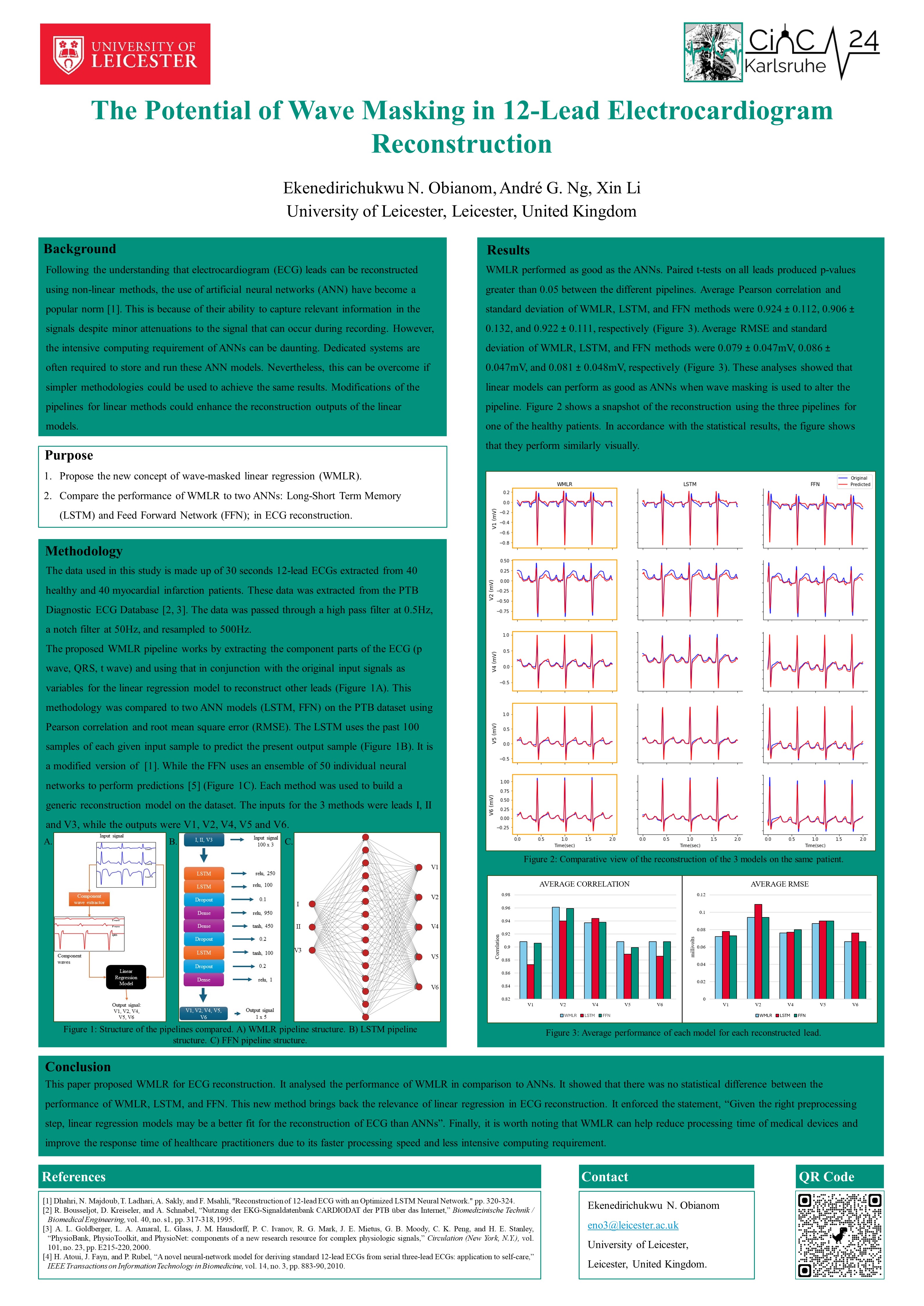
Following the understanding that ECG leads can be reconstructed using non-linear methods, the use of artificial neural networks (ANN) have become a popular norm. However, the intensive computing of ANNs can be daunting. This can be reduced if simpler methodologies could be used to achieve the same results. For this reason, this paper proposes Wave Masked Linear Regression (WMLR) method and compares it to two ANNs, Long-Short Term Memory (LSTM) and Feed Forward Network (FFN).
These methodologies were compared on 80 patients from PTB database. The dataset included 30s ECG resampled to 500hz. The inputs for the methods were leads I, II and V3, while the outputs were V1, V2, V4, V5 and V6. Each method was used to build a generic reconstruction model on the dataset. Pearson correlation (r) was used to compare the reconstruction of each model to the original signal. WMLR performed as good as the ANNs. Paired t-tests on all leads produced p-values greater than 0.05 between the methods. Mean r of WMLR, LSTM, and FFN methods were 0.924 ± 0.112, 0.906 ± 0.132, and 0.922 ± 0.111 respectively. This showed that linear models can perform as good as ANNs when wave masking is used to alter the pipeline.
This was presented in the CinC 2024, Karlsruhe, Germany. The link to the full paper is:
Leave a Reply